
An historiography assignment asks for comparisons of historical arguments on a given subject. Focus your search on academic/scholarly articles rather than journalism or other popular press sources. Make sure you are searching scholarly databases. That will make finding material to compare easier and the sources more authoritative.
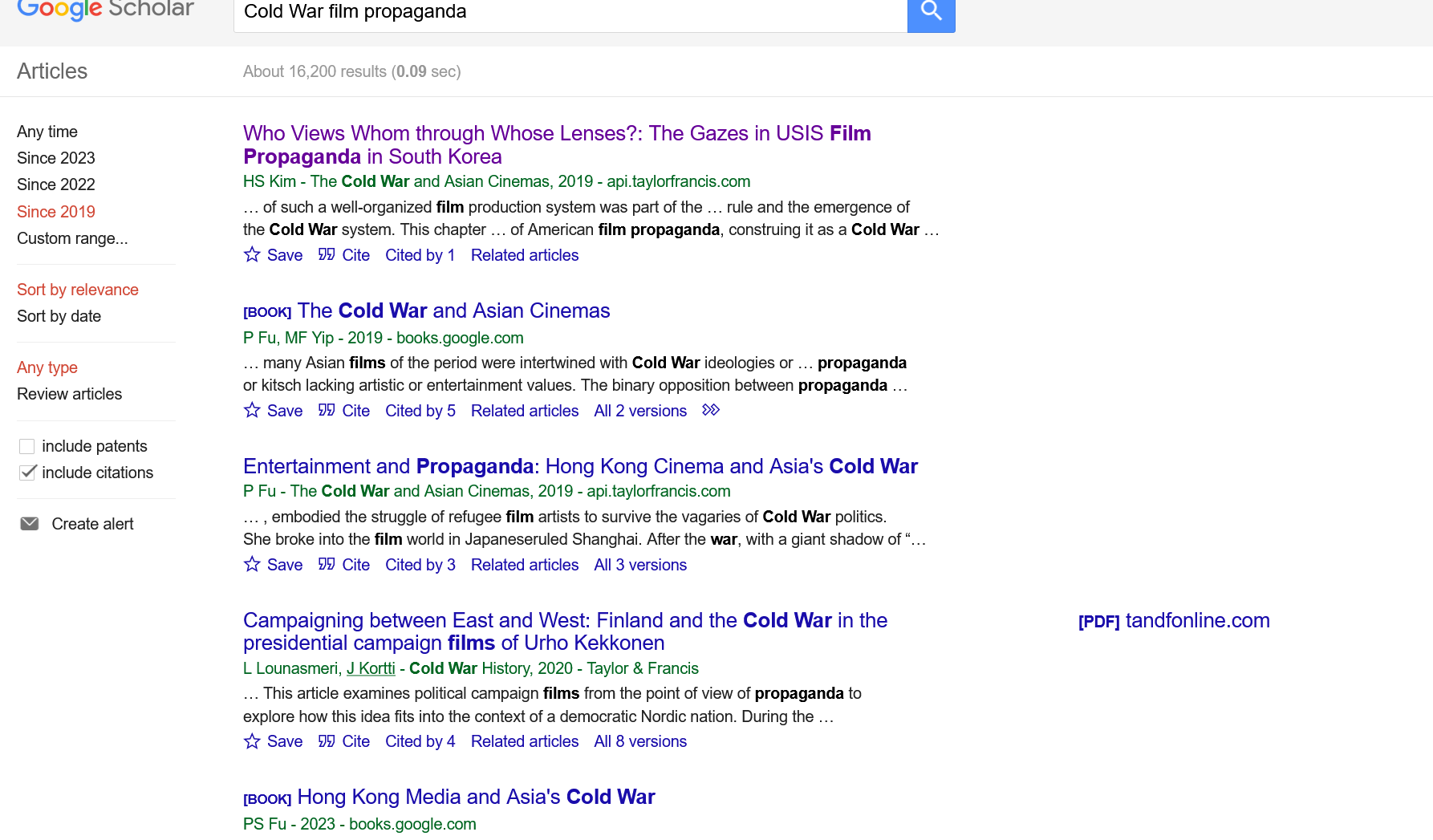
Step 1. Look at history-focused articles in the academic press in Cal’s university library. Log in and narrow your search to academic journals and peer-reviewed on the left hand side of the library menu. You are looking for journals with writers who debate media history subjects. (FYI: you might need to use the library proxy VPN if off campus). You might also use Google Scholar to explore potential articles for comparison using these steps.
Step 2. Open the journal and search some aspect of media history you would like to explore. For example, you might be interested in the history of women and media. So, one would search within the journal for anything that mentions these subjects. Articles will always be historical in these journals, so I find this article:
Television—the Housewife’s Choice? The 1949 Mass Observation Television Directive, Reluctance and Revision by Helen Wood.
I would then quickly examine the argument as outlined by the abstract. Then, I would continue searching abstracts of other articles (or book chapters) with key words related to TV, Housewives in the post-WWII era. Once I find one that addresses the same subject, I would analyze how the pieces differ in approach, argument, types of sources used, and any assumptions the authors bring to the analysis of postwar women and TV.
A Google Scholar search for keywords “Cold War Film Propaganda” shows a number of potentially comparable research articles. You would likely need to use your library database (or an on campus computer) to get access.
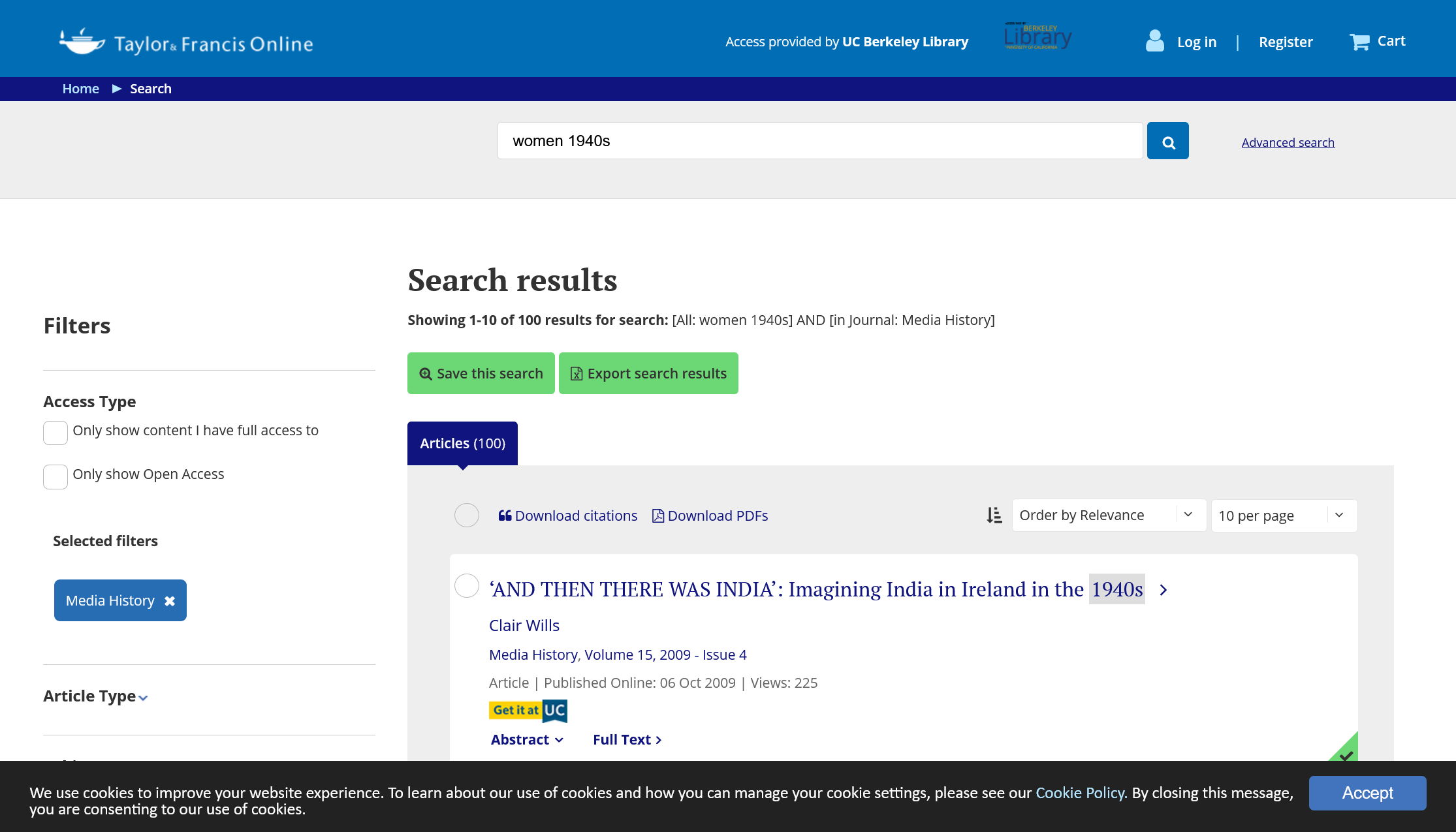
Step 3. Next, I would look at the abstract. That is the summary at the beginning. If I like it, I put it aside for later reference. Before reading the full article, I would examine the abstracts of other articles addressing the same subject and time period (authors writing about women and media in the 1940s or WWII film propaganda). Find two that seem to speak to one another in topic. The two authors may make similar or contrasting central arguments, but your task is to examine how they differ in argument, historiographical perspective, methods or archives used, etc. In the process, summarize the authors’ arguments, referencing the primary sources and methods where relevant.
That should be a good primer to point you in the right direction to do some basic historiography.


 Media In The Middle