Free Speech and FCC: Trump’s Controversial Policies

FeaturedFree Speech and FCC: Trump’s Controversial Policies

New administrations bring with them a new philosophy of governance. This is true of media governance as well. The pendulum swing from Democratic to Republican control of the presidency is, at times, a significant shift in media governance. Executive orders, proposed legislation, new commission leadership, and new telecommunications priorities all follow.

Here, we will watch some of these changes introduced by Trump’s second term. Tracking the shift in media governance is particularly important with this new administration.

Why? A couple of reasons. First, Trump has had great success challenging the mainstream press, particularly when outlets like CNN or the New York Times repeat elite, institutionalist criticism of Trump. He has made a meal of labeling criticism as “fake news.” The attack resonates with a skeptical American public that has historically low trust in TV news.

Second, these attacks resonate with an American public that has historically low trust in TV news. The Trump campaign’s rhetorical skewering of “mainstream media” resonates with his core voter base. Hundreds of thousands of his supporters feel aggrieved. They do not trust the American media system, and, when Trump supporters appear in outlets like CNN, they often experience condescension rather than representation. As a result, basic functions of the press like reflecting public will and fact-checking government have been crippled. A democratic media system cannot function without public legitimacy.

This dynamic between the politician and his supporters means we can anticipate some radical proposals in FCC actions, how content regulation evolves, and how private media companies cover politics.

Will broadcast licenses be challenged for how private news companies reported on the White House? How will coverage of immigration debates adapt to a new legal environment of threats from the FCC? Will the billionaire owners of social media companies fall further in line with Trump’s directives in response to the content moderation requests from the Biden administration? How will Trump’s FCC and Department of Justice use existing law to reshape the American news system?

We will attempt to chart some of these changes in order to better understand how media policy serves the presidency and what kind of social goals Trump 2.0 appears to pursue with policy and law. This record will be an ongoing and periodically updated.

Trump 2.0: Executive Orders and FCC Media Bias Investigations

Right out of the gate, Trump’s team has set out an agenda with the release of an Executive Order and a change in FCC leadership. Let’s examine recent FCC decisions before turning to the White House EO.

Brenden Carr, a first-term Trump appointee and telecommunications lawyer, has taken leadership of the FCC. Telecomm wonks like Carr are not known for partisan statements. In fact, telecomm policies are rarely framed as a right-left debate in public. No surprise then that Biden renominated Carr in 2023 despite Carr being a Trump appointee and harsh critic of Biden’s presidency.

Carr, however, seems to break from this non-partisan tradition. In a 2020 interview, Carr said, “[s]ince the 2016 election, the far left has hopped from hoax to hoax to hoax to explain how it lost to President Trump at the ballot box.”

Carr is not just shooting off rhetoric. Less than a week into his new role as head of the commission, he has started “bais investigations” into CBS, NBC, ABC. NPR and PBS are also under the gun for, ostensibly, accepting sponsorship support while also receiving federal funding. The underlying motive is more likely to starve media that remain shielded from executive coercion and quiet independent voices that might undermine government control of political narratives.

Carr’s legal moves do not seem in-line with Trump’s Executive Order of January 20, 2024. Section 2 of the Executive Order states:

Sec. 2.  Policy.  It is the policy of the United States to: (a)  secure the right of the American people to engage in constitutionally protected speech; (b)  ensure that no Federal Government officer, employee, or agent engages in or facilitates any conduct that would unconstitutionally abridge the free speech of any American citizen; (c)  ensure that no taxpayer resources are used to engage in or facilitate any conduct that would unconstitutionally abridge the free speech of any American citizen; . . .

The executive order is a case study in why policy pronouncements fail when they are muddied by partisan rhetoric. And let’s be clear that is what is happening. The order mirrors the aggressive campaign style but accomplishes little in terms of media law and policy due to self-contradiction.

As policy, the EO falls apart In the larger context of executive branch actions. Specifically, FCC Chairman Carr’s investigation of American news outlets appears to violate the spirit of Section 2. Section 3(a) states “[n]o Federal department, agency, entity, officer, employee, or agent may act or use any Federal resources in a manner contrary to section 2 of this order” (EO, Jan 20, 2025).

Carr’s FCC has done precisely what Trump’s Order appears to prohibit.

What policy documents do

Policy documents help industry leaders craft business plans. Partisan pronouncements, by contrast, are less helpful. They aim to undermine competitors for power rather than spell out the administration’s approach to media governance. Those watching the administration’s early moves to better anticipate regulatory conditions will have to wait.

Inconsistent policy is a sign of poor coordination among leadership at the White House Office. It is also a sign of incoherent principles guiding the new administration.

the basics: free speech law and tolerating political speech

Historically, media content regulations have been viewed as anti-American. Aside from the usual prohibitions against indecency (think: wardrobe malfunctions) and incitement, it has been mostly unthinkable to formally investigate news outlets for having political leanings. The behemoth partisan presence of Fox News in American politics under Democratic administrations is an obvious example. Fox’s “fair and balanced” news underscores the tolerance for criticism entailed by free expression law. The Biden, Obama, and Clinton administrations all begrudgingly accepted antagonism of Fox News personalities. These administrations embraced fair and unfair criticism as part of the job.

Why? Because prosecuting or regulating private media companies for perceived political bias is not just unthinkable. It is unconstitutional. The First Amendment prohibits Congress from “abridging the freedom of speech, or of the press.” These administrations understood diversity of opinion was more valuable to American government than silencing political speech. The president needed to answer critics.1

Free expression is a cornerstone or American media law and culture. The Trump administration has sent up some confusing signals about actual media policy that will define Trump’s second term. One early Executive Order claims to “end federal censorship” of the Biden administration . . . even as Trump’s FCC appears to be attempting to quiet the speech of major news outlets like CBS and NPR.

We will continue to watch media policies of Trump 2.0 as they take shape over the next four years. Free expression has a long tradition in the United States. However, free expression traditions are not guaranteed to remain unchanged in this political climate. Both the White House and a growing number of Americans are doubtful of American media and the legal environment that allows vigorous debate and criticism of government. Tracking policy changes will at least give us a glimpse into the new directions in store for the American public sphere. Stay tuned!

1 The First Amendment’s speech clause has expanded throughout the American system to include state legislatures, even including public universities which are disallowed from punishing students for social media posts since they are government institutions.

2 The presidency is no exception to First Amendment prohibitions, though it is worth noting the Supreme Court never ruled on John Adams’s Alien and Sedition Act, a censorship and deportation law of the early republic period that reflects the Trump administration’s agenda.

An American politics of symbols, or the triumph of “symbolitics”

FeaturedAn American politics of symbols, or the triumph of “symbolitics”
Mario Tama, Getty Images

“Climate skepticism has become a tenet of populism — a revolt against elitist scientists and liberal politicians seeking excuses for social and economic control. The denial of climate change has become a cultural signifier, the policy equivalent of a gun rack in a truck.”

-Washington Post opinion columnist

“When [Trump] makes claims . . . the press takes him literally, but not seriously; his supporters take him seriously, but not literally.”

The Atlantic, September, 2016

“I think a lot of voters who vote for Trump take Trump seriously but not literally, so when they hear things like the Muslim comment or the wall comment, their question is not, ‘Are you going to build a wall like the Great Wall of China?’ . . . What they hear is we’re going to have a saner, more sensible immigration policy.”

-Paypal co-founder and Trump supporter, Peter Thiel

Political polarization has shifted how Americans self-identify, and much of this recent transformation stems from symbolic forms of civic engagement. The political animosity that has a stranglehold on politics – harbingers of civil war for a worried few – suggests Americans are increasingly reliant on politics of symbols to frame our personal identities and interpret power in 21st century American life.

This is frustrating for journalists who wring their hands over “fact-free” discourse or new media misinformation. And it’s understandable given journalism is ostensibly a fact-based profession. But the mainstream press may have a problem of being naively literal in an increasingly symbolic political world.

Much of the journalistic marveling, some quite condescending, is in response to Trump’s voter base. To understand the disconnect between professional journalists and Trump’s base, we should recognize how a marriage of entertainment and political culture fueled his political rise. Television fandoms from the entertainment culture -The Apprentice, World Wrestling Entertainment- took the small step into the public sphere. As Trump’s familiar face from entertainment media moved into political media, the 2016 campaign drew on that television audience.

But it did more than draw voters. It also imported the logics of reality TV. Ratings took on heightened importance. Crowd size became worthy of debate. The political theater took on the carnival atmosphere of a wrestling arena in which voters could organize around the symbols of heroism and villainy. Entertainment culture colonized the political realm and imported the energy and emotion of reality TV.

Part of the entertainment-politics melding is a fuller shift of political reasoning from a messy world of policy details to a clean and easily understood world of symbolic narratives in which moral assertion displaces analytic nuance. The preference for the digestible world of symbols over factual debate precedes Trump but reached new proportions with his presidency and will likely continue beyond it.

It might be wise to more fully recognize how American politics has become a game of cultural signifiers. And yet, elite newsrooms are unable to recognize the symbolic language of American citizenry. For many, American politics is a game of bipolar brinkmanship dealing in mythic symbols that funnel debate into an either/or dynamic of the two-party system. 

We can hear it in casual conversations among the politically like-minded: “I could never date a Republican.” Or in how we regard politically mixed marriage: “I wonder what it is like at THAT dinner table!” In modern America, fathers are more likely to object to daughters bringing home the political opposition than a love interest of a different race. As Iyengar and Westwood put it, “party cues exert powerful effects on nonpolitical judgments and behaviors.” A politics-first identity has subsumed other social roles, and we can see it in reports of estranged family members and politically severed friendships.

Viewing political orientation as a deal-breaker in our romantic lives and wondering at “political miscegenation” underscore how partisan identities have taken a more central role in our broader social lives. Though the democratic ideal says we “should” vote according to tangible identities of self-interest (a small business owner or cancer survivor or blue-collar worker) we increasingly rely on artificially binary identities crafted by a symbol systems of commercial media and political elites. 

Today, we are less likely to participate in politics as ourselves. Instead, we participate as “real Republicans” or “true progressives.” We act as representatives of packaged ideologies rather than individuals directly voting for a better life through self-governance. I suspect the “symbolification” of political culture is both a symptom and a cause in this process.

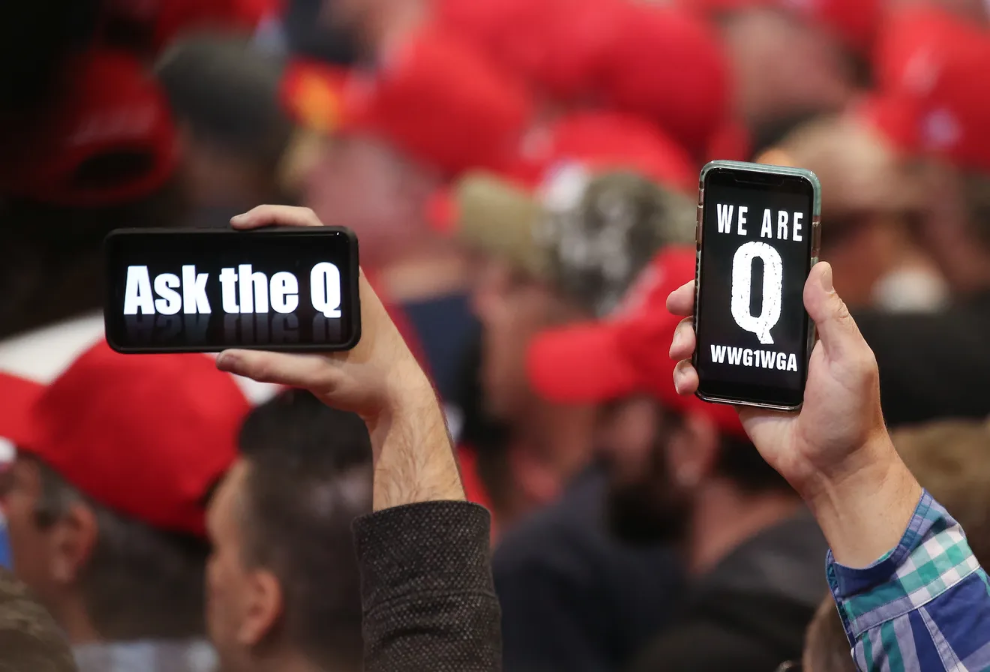
Reporting QAnon: a symbolic politics

Q symbol with glitch effect illustration.

What are the consequences when American politics, already prone to partisan theater, embraces an affective world of symbolism? To what degree do polarized cultural identities in the political realm necessitate the conversion of policy battles into symbols or battles over mere symbols?

These are ponderous questions, but I can map out some potential fallout.

First, the increasing power of symbolic communication in high politics has consequences for traditional understandings of democratic politics that are built into professional news frames.  

Symbolification distances public debate from the actual machinery of government. Instead of addressing the confusing details of healthcare or the tax system, symbols stand in with broad caricatures of the issue and the political agents that represent them. Symbolic politics offers a cast of evil-doers and heroic figures fighting for politically vague but symbolically meaningful goals. 

The degree to which policy debates devolve into symbolic representation is a fair approximation of the degree to which citizens directly control their government. A shallow symbolic system can replace details of party platforms or voting records. As a result, citizen judgement is one step removed.

Second, importing the symbols of entertainment culture may exacerbate partisan divisions. As differing symbolic systems ensconce and separate American subcultures, unifying themes of nationality weaken. Participation in politics through symbolic representations allows the public to address very different worlds with little hope of solving the very real social problems facing the nation. A common creed that has historically shored up American identity fragments along the fault lines of confirmation biases. The symbolic center cannot hold.

Finally, the reliance on symbols to navigate American politics plays into the vagaries and smoky mysticism of conspiracy mongers. Why would an American raise doubts about the American moon landing? Taken literally, the claim is absurd. Taken symbolically, it captures a broad suspicion that government is deceitful and so power-hungry that it would orchestrate a grand public deception to achieve “its” goals. The specific theory that the moon landing was faked does not itself need to be true as a symbolic representation of a calloused, elite government manipulating the public. The conspiracy is “true” even if Lance and Buzz actually took that one small step.

This is why literary semiotics may be a better tool for understanding American politics than political science or a burst of polls calculated, correlated, crunched and recrunched. The role of symbols in movements inspired by QAnon illustrates how current tools of of professional journalism produce blindspots in political analysis.

QAnon: reading conspiracies as semiotic politics

“. . . conspiracy theory [is[ an entertaining narrative form, a populist expression of a democratic culture, that circulates deep skepticism about the truth of the current political order throughout contemporary culture.” (Fenster 1999, pg. xiii).

Politics is rather boring in the details. That’s why C-Span is not a ratings hit. Watching senators argue policy in front of an empty chamber is mind-numbing and, frankly, uninformative for anyone but DC insiders or beat reporters. 

By contrast, online corners of conspiratorial thought like QAnon give gripping narrative structure to the sense of powerlessness in modern America. From the electoral college to tax policy, American democracy has features that are glaringly elite. QAnon merely gives a narrative to a fundamental truth felt by many Americans: powerlessness.

What is QAnon? The group is known for its wildest assertion that a cabal of Satan-worshipping elites control key government and media operations. This secret organization is engaged in child sex crimes at a massive scale. In some versions, these elites consume children’s blood to extend life or otherwise sustain themselves.

QAnon researchers have found no coherent, single narrative that defines the movement. Under the umbrella of QAnon, there are factions who have “different ideas about who the cabal is and what their ultimate goals are . . . but they are united in the belief that everything is a lie and the order needs to be destroyed.” It is more a patchwork of unorthodox explanations of power in America.

Taken literally, the conspiracy movement fails tests of evidence required by professional journalists as well as classrooms and the courts. If we de-emphasize the narrative specifics and read these beliefs as metaphor (don’t take it literally but take it seriously), the basic structure of the theory is true. As metaphor, the narrative is a archetypal story of the powerful preying on the weak. 

In fact, wealth gaps and power divisions do define modern America. Two-thirds of U.S. senators’ net worth exceeds $1 million. As Pew researchers note, income growth in recent decades has tilted to upper-income households and the middle class has shrunk. Nearly three-quarters of all employees live paycheck-to-paycheck in 2020. The popular vote often fails to elect presidents, defying the public will for arcane legalistic reasons. Given these conditions, the myth created by “Q” can make sense emotionally even if it fails intellectually.

We can understand the more outrageous conspiracy theories as a consequence of America’s crippled ability to recognize class conflict. If a group of people don’t have a language of class-based oppression -e.g. “haves and have nots”- they turn to alternative explanations for the inequality they feel. Pedophilia stands in as a morally charged symbol for victimization. 

On the other side of this growing economic disparity, the investor class buys and sells holdings according to the logic of financial capital. If their children don’t earn admission to prestigious schools, the elite bribe their way into East and West coast schools. 

This is why QAnon functions a redemption narrative comparable to Christian religious movements. It involves faith in something deeper than facts show us and belief without clear evidence. However far-fetched, conspiracy paints a symbolic picture that explains the sense of powerlessness felt by many.

At once, “Q” offers a way to resist that oppressive force. It provides comfort by painting a world of stark good and evil in which clear heroes work to save the faithful and punish the villainous. Adherents decode and scrutinize the meaning of Q’s pronouncements like ecclesiastical priests engaged in Biblical hermeneutics. Retweeting Q or interpreting Q’s “drops” becomes an act of defiance by speaking truth to nefarious but poorly understood power in America. The congregants evangelistically hope to reveal the truth to nonbelievers and instigate a “great awakening.” 

A symbolic analysis of culture might produce more useful maps for navigating this strain of American politics, and it certainly reveals more than the quantitative approach taken by poll-obsessed news networks that treat elections like horse-races. As symbolism displaces more direct citizen engagement with matters of government, the assumptions of political journalism become less reflective of actual political processes and opinion formation in American life. 

The growing wedge between mainstream news and parts of the American public stems from these divergent epistemologies. Traditional journalism functions as a gatekeeper, filtering the non-factual out of public discourse. The growing part of the American public who engage with politics though symbolic narratives see this realist epistemology as censorship and oppression. News perpetuates a fiction that numbers are an accurate representation of reality. Journalists, true to their professional training, dismiss counterfactual political thoughts with a myopic literalism.

But the political class only shoots itself in the foot when it dismisses symbolic discourse. New York Times columnist, David Brooks, argues that “personal contact” is the way to “[reduce] the social chasm between the members of the epistemic regime and those who feel so alienated from it.” Journalists may not be able to personally reach out to the alienated, but newsrooms can certainly pay greater attention to the symbolic dimensions of political culture and better understand the reality buried in the myths that shape the “paranoid style” of American politics. 

Symbols have and will always play a role in political movements. Just look at the flags arrayed during the Capitol riots. It is uncertain, however, if 21st century journalism can develop analysis that both maintains fact-based discourse and productively accounts for the emerging centrality of symbols in political life. But a wholesale shift to symbolic public discourse threatens to unmoor democratic participation from meaningful self-governance.