The most significant example of disinformation is partisan fabrication woven into assumptions of the policy making process. Misinformation damages public discourse, of course, but falsehoods at the root of policy can have far-reaching consequences for the U.S. legal system. We can see this hidden role of “fake news” in Executive Orders of Trump’s second term.
Shortly after taking office, the new administration issued the Executive Order, “Restoring Freedom of Speech and Ending Federal Censorship.” The order flatly asserts Trump’s partisan attack:
“Over the last 4 years, the previous administration trampled free speech rights by censoring Americans’ speech on online platforms, often by exerting substantial coercive pressure on third parties, such as social media companies, to moderate, deplatform, or otherwise suppress speech that the Federal Government did not approve.”
It is no surprise that the administration uses Executive Orders as a partisan tool. Trump has successfully used state power to exact vengeance on political enemies. As he enlists the levers of state to do so, we can see how his self-serving version of reality thorns its way into policy.
Was the Biden administration violating American speech freedoms as the premise of the order would have us believe? The courts did not agree. Conservative justice Amy Coney Barrett found “[t]he plaintiffs fail, by and large, to link their past social-media restrictions and the defendants’ [Biden administration] communications with the platforms.”
Twitter executives, dragged before the Republican-run House Oversight Committee, denied a similar charge that Democrats had coerced Twitter to remove information about President Biden’s son, Hunter.
And yet, there it is, shaping policy priorities for the federal government.
In many ways, this is classic Trump governance. Executive Order as rhetorical attack. Perpetual campaigning; little meaningful governance. When policy grows from misperception or misinformation, it hobbles policy as a solution to American problems.
The bellicose language of the order illustrates something unique about the administration. Exaggeration and partisan attacks replace more precise legal language that is more common in policy documents meant to give direction and legal structure to American citizens and industries.
Misinformation becomes a more urgent problem when falsehoods infect legislative and legal actions. They underscore a MAGA style of governance: reorient the levers of policy-making to serve partisan spectacle. The consequences are concerning. Policy efforts are misdirected. The public is falsely reassured. Government resources are wasted as federal workers try to take action on an issue the president imagined into existence. The irony is thick as Trump sues and cajoles private news media companies. America tilts at Trump’s windmills while real problems go unaddressed.
New administrations bring with them a new philosophy of governance. This is true of media governance as well. The pendulum swing from Democratic to Republican control of the presidency is, at times, a significant shift in media governance. Executive orders, proposed legislation, new commission leadership, and new telecommunications priorities all follow.
Here, we will watch some of these changes introduced by Trump’s second term. Tracking the shift in media governance is particularly important with this new administration.
Why? A couple of reasons. First, Trump has had great success challenging the mainstream press, particularly when outlets like CNN or the New York Times repeat elite, institutionalist criticism of Trump. He has made a meal of labeling criticism as “fake news.” The attack resonates with a skeptical American public that has historically low trust in TV news.
Second, these attacks resonate with an American public that has historically low trust in TV news. The Trump campaign’s rhetorical skewering of “mainstream media” resonates with his core voter base. Hundreds of thousands of his supporters feel aggrieved. They do not trust the American media system, and, when Trump supporters appear in outlets like CNN, they often experience condescension rather than representation. As a result, basic functions of the press like reflecting public will and fact-checking government have been crippled. A democratic media system cannot function without public legitimacy.
This dynamic between the politician and his supporters means we can anticipate some radical proposals in FCC actions, how content regulation evolves, and how private media companies cover politics.
Will broadcast licenses be challenged for how private news companies reported on the White House? How will coverage of immigration debates adapt to a new legal environment of threats from the FCC? Will the billionaire owners of social media companies fall further in line with Trump’s directives in response to the content moderation requests from the Biden administration? How will Trump’s FCC and Department of Justice use existing law to reshape the American news system?
We will attempt to chart some of these changes in order to better understand how media policy serves the presidency and what kind of social goals Trump 2.0 appears to pursue with policy and law. This record will be an ongoing and periodically updated.
Trump 2.0: Executive Orders and FCC Media Bias Investigations
Right out of the gate, Trump’s team has set out an agenda with the release of an Executive Order and a change in FCC leadership. Let’s examine recent FCC decisions before turning to the White House EO.
Brenden Carr, a first-term Trump appointee and telecommunications lawyer, has taken leadership of the FCC. Telecomm wonks like Carr are not known for partisan statements. In fact, telecomm policies are rarely framed as a right-left debate in public. No surprise then that Biden renominated Carr in 2023 despite Carr being a Trump appointee and harsh critic of Biden’s presidency.
Carr, however, seems to break from this non-partisan tradition. In a 2020 interview, Carr said, “[s]ince the 2016 election, the far left has hopped from hoax to hoax to hoax to explain how it lost to President Trump at the ballot box.”
Carr is not just shooting off rhetoric. Less than a week into his new role as head of the commission, he has started “bais investigations” into CBS, NBC, ABC. NPR and PBS are also under the gun for, ostensibly, accepting sponsorship support while also receiving federal funding. The underlying motive is more likely to starve media that remain shielded from executive coercion and quiet independent voices that might undermine government control of political narratives.
Carr’s legal moves do not seem in-line with Trump’s Executive Order of January 20, 2024. Section 2 of the Executive Order states:
Sec. 2. Policy. It is the policy of the United States to: (a) secure the right of the American people to engage in constitutionally protected speech; (b) ensure that no Federal Government officer, employee, or agent engages in or facilitates any conduct that would unconstitutionally abridge the free speech of any American citizen; (c) ensure that no taxpayer resources are used to engage in or facilitate any conduct that would unconstitutionally abridge the free speech of any American citizen; . . .
The executive order is a case study in why policy pronouncements fail when they are muddied by partisan rhetoric. And let’s be clear that is what is happening. The order mirrors the aggressive campaign style but accomplishes little in terms of media law and policy due to self-contradiction.
As policy, the EO falls apart In the larger context of executive branch actions. Specifically, FCC Chairman Carr’s investigation of American news outlets appears to violate the spirit of Section 2. Section 3(a) states “[n]o Federal department, agency, entity, officer, employee, or agent may act or use any Federal resources in a manner contrary to section 2 of this order” (EO, Jan 20, 2025).
Carr’s FCC has done precisely what Trump’s Order appears to prohibit.
What policy documents do
Policy documents help industry leaders craft business plans. Partisan pronouncements, by contrast, are less helpful. They aim to undermine competitors for power rather than spell out the administration’s approach to media governance. Those watching the administration’s early moves to better anticipate regulatory conditions will have to wait.
Inconsistent policy is a sign of poor coordination among leadership at the White House Office. It is also a sign of incoherent principles guiding the new administration.
the basics: free speech law and tolerating political speech
Historically, media content regulations have been viewed as anti-American. Aside from the usual prohibitions against indecency (think: wardrobe malfunctions) and incitement, it has been mostly unthinkable to formally investigate news outlets for having political leanings. The behemoth partisan presence of Fox News in American politics under Democratic administrations is an obvious example. Fox’s “fair and balanced” news underscores the tolerance for criticism entailed by free expression law. The Biden, Obama, and Clinton administrations all begrudgingly accepted antagonism of Fox News personalities. These administrations embraced fair and unfair criticism as part of the job.
Why? Because prosecuting or regulating private media companies for perceived political bias is not just unthinkable. It is unconstitutional. The First Amendment prohibits Congress from “abridging the freedom of speech, or of the press.” These administrations understood diversity of opinion was more valuable to American government than silencing political speech. The president needed to answer critics.1
Free expression is a cornerstone or American media law and culture. The Trump administration has sent up some confusing signals about actual media policy that will define Trump’s second term. One early Executive Order claims to “end federal censorship” of the Biden administration . . . even as Trump’s FCC appears to be attempting to quiet the speech of major news outlets like CBS and NPR.
We will continue to watch media policies of Trump 2.0 as they take shape over the next four years. Free expression has a long tradition in the United States. However, free expression traditions are not guaranteed to remain unchanged in this political climate. Both the White House and a growing number of Americans are doubtful of American media and the legal environment that allows vigorous debate and criticism of government. Tracking policy changes will at least give us a glimpse into the new directions in store for the American public sphere. Stay tuned!
1 The First Amendment’s speech clause has expanded throughout the American system to include state legislatures, even including public universities which are disallowed from punishing students for social media posts since they are government institutions.
2 The presidency is no exception to First Amendment prohibitions, though it is worth noting the Supreme Court never ruled on John Adams’s Alien and Sedition Act, a censorship and deportation law of the early republic period that reflects the Trump administration’s agenda.
This is the simplified argument of Neil Postman, the quasi-famous cultural critic of the 1980s. Postman looked at television and saw a medium of great potential. The entertainment tv offered its audience was unparalleled. TV gave us live images from around the world. The spectacle was amazing. TV took families from their daily lives and transported us to 1000s of imaginary worlds. We escape the grind of paying bills, family squabbles and workdays through TV. But, Postman argued, TV is also supremely ill-suited for the “serious stuff” of news and public affairs.
Many are concerned about fake news on Facebook, but what is the alternative? A return to CBS network news? Should we look to cable’s CNN? Reanimate Walter Cronkite?
Sad news, folks. If Facebook hurts an informed electorate, network and cable news are handmaidens in the erosion of American political intelligence. Let’s look at CBS and CNN for evidence.
Three Pieces of Evidence Commercial News Will Fail Us
Evidence 1: Media executive values; the Moonves Doctrine
CBS chairman, Les Moonves, commented on the relationship between commercial media and Trump’s campaign. “It may not be good for America, but it’s damn good for CBS,” he said, candidly. He continued, “[m]an, who would have expected the ride we’re all having right now? . . . The money’s rolling in and this is fun.” Speaking to CBS stockholders, Moonves was pleased with the “circus.” “I’ve never seen anything like this, and this is going to be a very good year for us. Sorry. It’s a terrible thing to say. But, bring it on, Donald. Keep going.”
If a skeptical reader thinks one statement from a media executive is not enough, here is some evidence that Moonves’s reckless commercialism is the operational logic for the American commercial news.
Evidence 2: News coverage: a Trump Narrative
Trump received excessive coverage from news organizations. These breathless and bemused reports function as free publicity (“Earned Media”), keeping the Trump campaign in control of the news narrative. Researchers estimate commercial news offered what amounted to $2-3 billion in free advertising for Trump. Who says you are wasting time with those 2AM tweets? It worked for the president.
The “Moonves doctrine” is quite influential. So much so that news directors preferred no news over actual news. During the 2016 campaign, CNN, Fox and MSNBC broadcast an empty Trump podium while Mrs. Clinton was actually speaking to unions in Las Vegas.
Evidence 3: CNN Boss’s relationship with Trump reality TV.
What incentives do media executives have for creating a candied reality instead of offering unvarnished news of the day? Well, if news is to serve corporate profits, its job is to attract eyeballs rather than inform. Take current CNN chief, Jeff Zucker. Formerly the head of NBC Entertainment, Zucker played a major role in creating NBC’s The Apprentice, coordinating with Trump to create a show “built as a virtual nonstop advertisement for the Trump empire and lifestyle.” Zucker rode Trump’s celebrity up through the ranks at NBC. At the helm of CNN, he continued to profit from Trump and, by extension, helped create a media landscape in which Trumpist falsehoods could prevail.
News and Reality
News was the original “reality TV.” Now American media have corrupted the very idea of the real. Kim Kardashian is now “truer” than Wolf Blitzer. The New York Times (formerly “real”) describes reality as much as ABCnews.com.co (formerly “fake”). Gary Busey’s apprenticeship on Trump’s TV show is as real as Mitt Romney slavishly interviewing for Secretary of State.
The point? We should stop watching TV news. Just stop. Not because “reporters are biased.” Not because media owners have political agendas. We should because they do not offer news. They offer shiny packages to us and then sell our views and clicks. The shine matters more than truth. Anger and laughs over thought and insight. Profits matter more than an informed electorate. Ratings fuel Jeff Zucker’s shameless direction of CNN content. If we pay our attention, they will feed us more to get paid. Stop paying.
Postman said TV was dangerous nonsense in the 1980s. Turns out he was right about 2020. The good news? We don’t have to put up with it or deal with the messy business of resurrecting dead news icons. America may have voted, but we can still take action . . . or inaction.
Stop paying TV news attention. Starve the beast that is sustained by enslaving your mind. Demand better. You’ll be better for it; America might, too.
Trump and Cruz during the 2016 Republican primary debate on Fox Business Channel
“There is a broader dynamic at work, which is network executives have made a decision to get behind Donald Trump. Rupert Murdoch and Roger Ailes at Fox News have turned Fox News into the Donald Trump network.”
-Ted Cruz, two months after suspending his campaign to be the Republican nominee
I’m not used to agreeing with Ted Cruz.
But I might have to when it comes to his post-nomination view of Fox News. Did Trump (almost literally) steal the spotlight on cable news? If so, how?
The how is important. Cruz is content to paint Ailes, Murdoch and company at Fox News as overly powerful Republican kingmakers, but it is important not to be reductive about so-called media bias. Fox is equal parts commercial organization and deep-throated political beast. We need to properly understand bias to get at the how of Trump’s surprising rise in American politics.
Discussions of bias usually stall on the political question. Americans are often content to yell “conservative” or “liberal” bias and leave it at that. And it makes sense. Those of us in the US have been trained to expect balance and objectivity from their news. It is only natural that the public perception of Fox News emphasizes the right-leaning commentary on the channel.
Still, I believe this is short-sighted. Yes, Fox News is politically motivated. Yes, Fox News provides a platform for conservative voices . . . but these are surface observations of bias and fail to appreciate a core insight about media companies. Fox is also former subsidiary and (now) a profitable partner with News Corp. with holdings around the world and across media platforms. It is a company, like all companies, with the sole aim of generating revenue for shareholders. We should not forget this form of bias when we speculate on the rise of the Donald.
The 2013 company break up of News Corp. can tell us something about the role of the profit motive in corporate decision-making. When Murdoch insisted on buying up flagship newspapers like the Wall Street Journal, major investors in the conglomerate balked. Everyone in that corporate boardroom understood newspapers were dying a slow death by a thousand bytes. No profit-minded, voting board member saw the paper as a worthy investment, particularly compared to the revenues generated by non-publishing enterprises. Perhaps it was his father’s beginnings in publishing that made the media tycoon need more newspapers in his portfolio. Whatever the case, investors demanded a business break-up. Print would be financially quarantined under News Corp. while more lucrative holdings in film and television go to the newly created Fox Group. We see a sort of corporate philosophy at play: Murdoch’s “vanity” publishing properties should not undermine returns from TV and film. Other corporations, like the Tribune Company, followed suit.
The point is this. Media literacy demands we be wary of political motivations in our news. They abound. But we cannot let this obscure the business motivations that aim cameras in certain directions and send reporters to events. Commercial needs direct our media and, thus, our national conversation. With this in mind, we might better understand why Fox, MSNBC and CNN all mysteriously ignored other candidate speeches to broadcast, live, an empty Trump podium. What journalistic principles tell us that an empty Trump podium is more newsworthy than an actual Sanders speech after a rough primary? Other programming principles are influencing the decision, of course.
Cruz’s criticism is sound (even if surprising given how out of character it is for Republicans to accuse media of much more than the “liberal agenda”). The target of Cruz’s attacks, however, is Fox News. We assume there is no surplus of liberal agenda there. So how do we understand the preference for one kind of Republican over another? Though Cruz points to TV executives as handmaidens to Trump’s victory, we need to also ask about the larger structure of media. How we think about media power matters. Something bigger than political bias refines the selection process: the commercial bias.
If we extend Cruz’s criticism a bit, we see what worked against him. Trump has media power. This goes beyond his media savvy, his charisma and his experience in front of a camera on The Apprentice. Trump has something more. Media power is also “the economic, political and cultural impact of organisations that deal in information, symbols and narratives,” as Des Freedman puts it. When we marvel at Trump, we are also marveling at our media system.
Many Republicans are dismayed by American news in light of Trump’s primary rampage. “Look at what the media did to the Republican party,” they implore. Establishment candidates appeared to sag into lumps of poorly refrigerated meat as they sought to stay above the rhetoric and refused to engage Trump in the very familiar language of 140-characters-or-less. The Cruzes and Jeb!s tried to use the private media as a forum to persuade voters their policies were best; they were bested by a policy-light entertainer with his tiny, tweeting hands on the levers of private media.
So when mainstream Republicans lambaste the role of Fox News in propelling this reality television figure into frontrunner status or acerbically note Trump’s bumper-sticker policies in contrast to other candidates’ plans, every time they paint Trump as the clown at the “media circus,” there is a glimmer of recognition that commercial news is not responsible news.
If we look long enough (a kind of thousand yard stare of the shell-shocked) we can see a logical syllogism about media policy in Ted Cruz’s anger toward Fox News. One I don’t think the Texas senator would speak aloud, but one I wouldn’t mind hearing from campaigns more often: commercial media put Trump where he is today.
Premise 1: Commercial media’s primary function is to draw large audiences with disposable income for advertisers. NBC sells our eyes and ears to them. Ratings, therefore, are the prime metric guiding the behavior of corporate media enterprises.
Premise 2: Donald Trump draws public attention (i.e. eyes and ears as measured by ratings agencies) and “media power,” the social connections to key media figures that provide access to audiences and add to his personal publicity.
Trump’s media advantage goes beyond having a knack for statements that draw media attention like a fly to human waste. He has functional and productive relationships with those that craft both American reality TV and American news. When Buzzfeed reporters went through Trump’s various biographies, they found CNN’s Jeff Zucker lovingly featured several times, once in typical Trump fashion as a “total dynamo”.
From one of Trump’s several books on Trump’s love of dynamos.
Trump’s relationships with people like CNN president Jeff Zucker matter. A lot. It translates into what Politico has liken to “an experiment in free media.” Normally, candidates pay to communicate with audiences . . . like advertisers. Not Trump. The NYT estimated Trump had attracted $2 billion in free media coverage as his campaign and corporate media managers feed off of one another. In short, help weak cable ratings and get airtime for publicity.
We saw the commercial bias in action with the debates. Fox News’ debate in Detroit on March 3 drew an amazing 17 million viewers. Compare that to 5.5 million drawn by the Democratic debate in Flint, Michigan. Or compare 2016 to the 2012 Republican primary debates’ largest audience that year at 7.1 million. Trump has a magnetism that ratings-minded programmers cannot deny.
The Zucker-Trump alliance is long-standing . . . but more unnerving is what these two worked on: the creation of audience-attracting spectacles and catch phrases. As the success of Trump’s reality show carried NBC through a financially perilous time, Zucker learned how Trump was valuable to him as an NBC chief. Now that Zucker is leading CNN, what kind of value does Zucker see in brand Trump? CNN’s ratings jump with Trump on tap is telling if a bit disconcerting for those that favor deeper political conversations.
Trump’s unorthodox public relations style, honed in the ratings-focused cauldron of NBC’s sitcom lineup, pushes media manager to shift the editorial focus to Trump’s slightest move. The coverage? Trump unwittingly makes racist comment. Trump wittingly makes racist comments. Trump defends additional racist remarks. The most telling moment came with the “feud” instigated when Trump attacked Fox host Megyn Kelly. Not only did Fox News carry the Trump-Kelly drama to a ratings crescendo with Kelly’s awkwardly personal follow-up interview but other media outlets covered the tense public exchange as if an offended news personality were actual news the public needed. It had begun as a question about Trump’s regard for women and ended as a mildly flirtatious break-up/make-up worthy of any episode of The Bachelor.
So, we come to a testable hypothesis:
Conclusion 1: Figures who create public events which score better audience measurements will be preferred by commercial news’ editorial policies. Therefore, Trump will receive more coverage given the overlapping interests of the Trump campaign and commercial news producers.
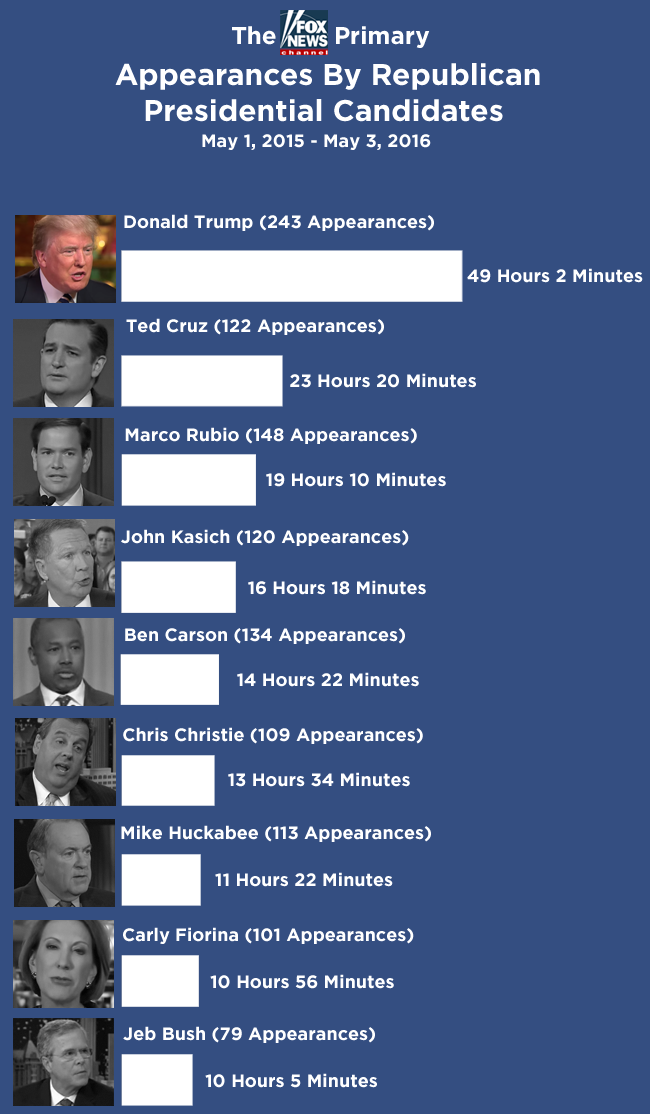
Evidence? Sure thing. The left-leaning media criticism group, Media Matters, crunched the numbers. Trump received nearly double the coverage of the candidate with the second-most airtime (Cruz). Said another way: Trump was considered two times more “newsworthy” than Sen. Cruz (see graphic).
source: Media Matters for America, 2016
Cruz’s assertion that Fox News had “taken sides” in the primary process may make media critics out of some Republicans, but it also points up the need to weigh the virtues and vices of a public culture driven by private companies. The “side” the news networks took was the one that grew viewership by any means possible. Donald was a means to that end. Trump seeks publicity. Commercial news is a means to that end.
Much of this will play out again during the Republican National Convention. What is a convention other than a publicity event? Both Trump and media executives, dynamos or otherwise, will use the event to achieve their goals.
But what effect will the hypercommercial nature of the American press have on the democratic process? Will disenfranchised Republicans pull the curtain back on Zucker, Ailes and the long list of media execs whose livelihood depends on courting the outrageous? Not likely. Republicans are loath to restrict the prerogatives of private corporations. But Cruz’s demise and the rise of Trump politics might awaken those on the right that a free market does not necessarily produce the best journalism for democracy. The irony of Cruz’s comment is that the Republican pro-business orthodoxy shaped the media system that helped defeat his White House bid. It also means the corporate media status quo will continue, despite having bitten one Republican hand that fed them.
Western responses to RT, Russia’s English-language news channel, have rekindled debates surrounding media globalization. Some relate to perspective diversity in a democratic media system. Should Western media regulators limit the ability of foreign news to reach audiences in Britain or the United States? Some relate to the contrasting definitions of what news is in a global media environment. If RT (formerly Russia Today) frames world events according to the Kremlin’s political or economic agenda, is it news or propaganda?
RT is state-sponsored and, by Western standards, departs from traditional assertions that news production should be independent of government. However, placing limits on viewpoint diversity violates basic principles: democratic publics deserve a media environment in which all views appear. The people will sort truth from falsehood. If government regulators were to limit RT, would it not be dictating what the public can or cannot see? Would that not commit the same sin that underpins criticism of RT as propaganda?
My colleagues and I sort through these questions in the following discussion of international news. We assert that even the modern hybrid of propaganda and news can make for a healthy public debate.
Who’s afraid of non-western propaganda channels?
The revelations early this year regarding editors at the British Telegraph newspaper pandering to the interests of megabank HSBC once again demonstrate the commercial limits to freedom of the press in the west. The good news is that the rise of non-western news channels has the potential to alleviate the western media’s weakness.
Western journalists, media critics and officials frequently lambast non-western, state-sponsored news channels like the Russian RT for distorting the truth in the interests of their financial backers. Fair enough. Yet such channels also serve a valuable, often-overlooked function. They provide reporting and perspectives on the west that its commercial media do not.
American Secretary of State John Kerry has denounced RT as a “propaganda bullhorn” that “has been deployed to promote President Putin’s fantasy about what is playing out on the ground in Ukraine.” There is indeed strong evidence that RT’s editorial line bends toward the Kremlin. RT anchor Liz Wahl resigned in protest against her channel’s pro-Russian coverage of the unrest in the former soviet republic. Another RT anchor, Abby Martin, also protested on air but did not quit her job.
Propaganda: deception or perspective?
But occasionally RT reports truths that are absent in mainstream western journalism. For example, western outlets have consistently heralded the Maidan Square protesters, who ousted Ukrainian President Victor Yanukovych in 2014, as opponents of corruption and supporters of freedom. By contrast, RT has emphasized the role that pro-fascist groups have played in the Ukrainian revolution and how they have been tolerated, if not supported, by western governments. RT’s coverage was also more likely to highlight the grievances of Ukrainians in the east.
Neither the western nor non-western journalistic story is complete, but RT’s existence provides western news consumers with a fuller picture of the events in Ukraine.
Such fears have grown especially acute after foreign news networks set up English-language channels, thereby directly challenging elite control of western public opinion. RT is perhaps the most prominent example, but the list includes Al Jazeera English, TeleSur English, Iran’s PressTV, and China’s CCTV America.
These outlets have not just been derided. Some have met concerted resistance from pressure groups who oppose their entry into western markets. For example, Honest Reporting Canada has filed complaints with Canada’s media regulator, expressing the fear that Al Jazeera would undermine political support for Israel.
Limits on foreign news
In the US, the greatest barrier to entry has been the disinterest of major commercial distributors. Al Jazeera America had such a hard time entering the US market that the network ultimately decided to buy Al Gore’s Current TV, solely for its distribution agreements with companies like Time Warner Cable.
Western audiences are warming to the different perspectives now available. While major US cable news networks have hemorrhaged viewers, foreign channels have grown their audiences and gained entry to more US markets. They also attract significant attention online.
The appeal stems in part from a crisis of confidence in commercial news. Many western viewers have become disaffected with their own media. They realize that channels backed by non-western governments offer value by creating space for critical journalism and providing a platform for activist and dissident voices.
Rather than demonizing or blocking outlets like RT, Al Jazeera, and Telesur, we should engage their perspectives. If their facts are wrong, we should counter with better information. If their arguments are illogical, we should counter with higher sense. Of course, adopting more speech as a solution for wrong speech ultimately requires that we trust the public to be able to come to sound conclusions about important matters.
Foreign news channels are here to stay. We can respond with derision and suppression, or we can renew our democratic commitment to sound journalism and widespread media literacy. By choosing the latter, such channels might end up enriching our democracy — even if that is far from the intention of their owners.
Ian Kivelin Davis teaches communication studies at Augustana College-Illinois, Rich Potter at the American Jewish University, and Tabe Bergman at Renmin University.





 Media In The Middle